Business simulation vs team building for companies
A decision guide for corporate programmes
For an international team in Europe, the UAE, Georgia or Kazakhstan, both formats bring colleagues together outside their usual routine. The useful distinction is what the meeting needs to produce: a shared social experience, or a structured conversation about a business issue through decisions, consequences and facilitated reflection.
Two formats, two different jobs
Classic team building often uses a shared activity: a treasure hunt, a physical challenge, a creative task, food or a short team game. It fits a programme whose purpose is to help people meet, mark a milestone, change pace and have an informal point of connection.
A business simulation gives participants roles, constraints, resources and a common challenge. Teams make choices, see consequences, adjust their approach and review what happened with a trainer. This format is useful when the meeting should lead into a practical discussion about leadership, communication between departments, change, motivation or partnerships. The Harvard Graduate School of Education guide to simulations describes them as active learning in realistic situations, with preparation and debriefing playing an essential part in making the experience useful.
A quick way to decide
- Choose team building when the brief starts with “help people meet”, “celebrate”, “reset” or “share an experience”.
- Choose a business simulation when the question is “why do departments lose information?”, “how do our managers lead change?” or “how can teams agree on a shared result?”.
- Combine the formats when the programme needs both informal contact and focused work. The order should reflect the available time, group profile and energy level.
Match the game to the company question
When information stays inside departments
Black Square gives participants different pieces of the same task. They have to share observations quickly and assemble one answer. A different captain leads each round. The debrief can examine who surfaced critical information, how the group tested competing interpretations and what changed when leadership moved. It can open a strategy session, retrospective or cross-functional workshop.
When departments have local targets but share one outcome
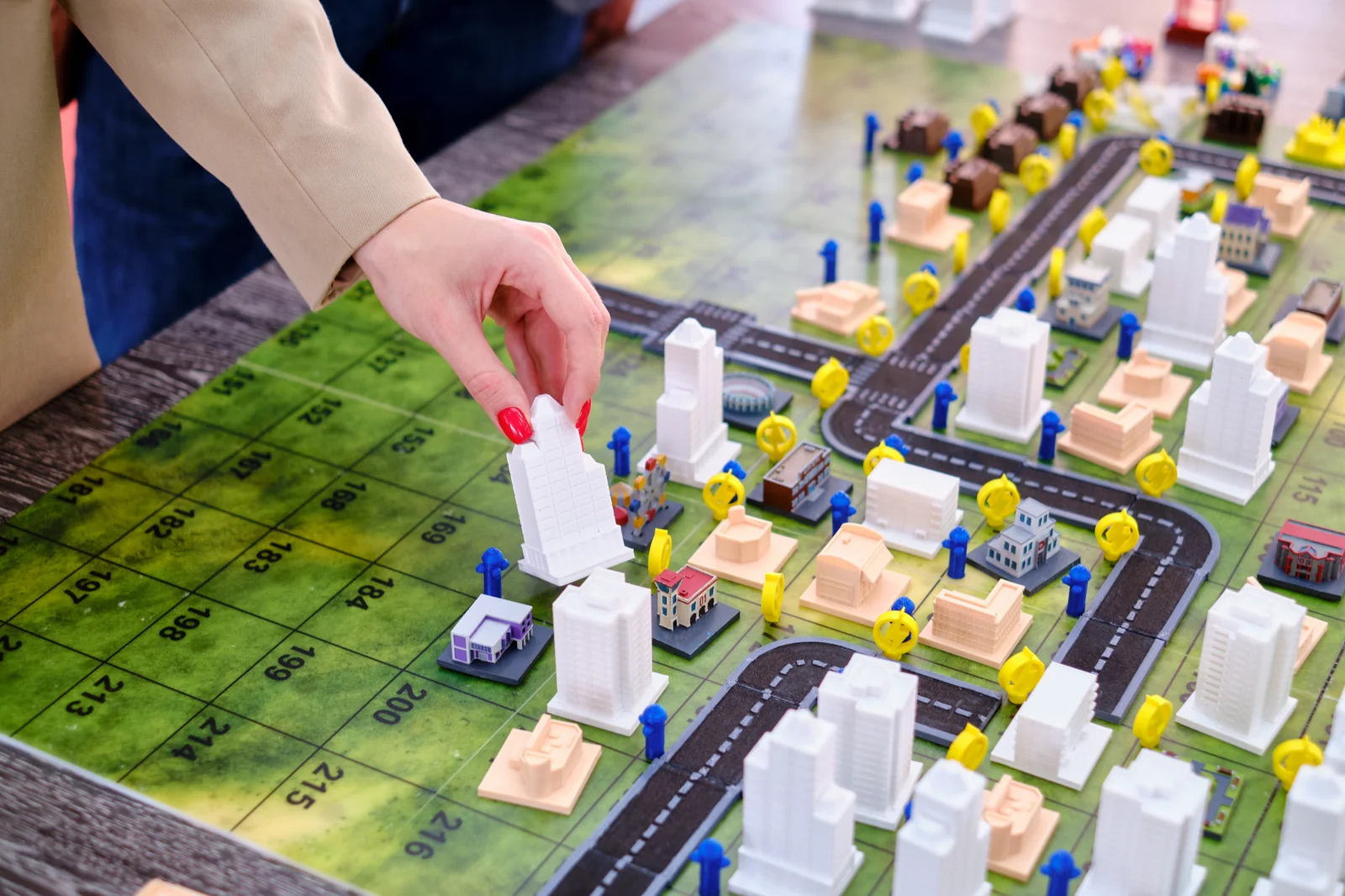
Happy City turns teams into construction companies. Each company earns its own rating, while the result also depends on the quality of the shared urban environment. Participants allocate resources, negotiate development and decide when a local advantage supports or obstructs the city. The model is easy to recognise in organisations where product, sales, marketing, operations and support depend on one another.
When managers need to lead change
Right the Helm unfolds over four rounds. Teams decide whether to begin a change, which implementation strategy to use, what to change and how to respond to different employee reactions. The discussion can compare management reasoning, arguments and approaches to negotiation with people who disagree. The format is designed for 8–50 participants and takes 4.5–5 hours including the game cycle and debrief.
When the focus is partnership, motivation or sustainability
Edges supports a conversation about partnerships, commitments, reputation and strategy in changing conditions. Incentive Space Simulation focuses on employee selection and a mix of financial and 28 non-financial motivation tools. The City for Life brings government, business and residents together around a city’s environmental, social and governance indicators. Each game opens a different business question, so the subject of the session should come before the choice of scenario.
A practical brief for choosing the format
An organiser can prepare seven points:
- One business question the team should discuss after the programme.
- Participant numbers, roles, departments and how well people know one another.
- Delivery language and whether the group needs more than one language.
- Available time for instructions, play and facilitated debrief.
- In-person, online or hybrid delivery, plus venue and equipment constraints.
- The interactions worth observing: information sharing, negotiation, leadership or resource allocation.
- The person who will record agreements and revisit them with the team.
When the brief centres on celebration, connection and a shared experience, team building is the natural starting point. When it contains a specific work question, a facilitated simulation creates material for a more focused discussion. This keeps the choice tied to the company’s purpose. Delivery can be discussed for an international group in Europe, including Cyprus, as well as the UAE, Georgia and Kazakhstan.